Market and Technology Review: The Global Adhesives & Functional Bonding Industry
 Devyesh Rana
39 min read
Section 1: Executive Overview & Macro Industry Dynamics
- 1.1 Market Sizing & Macro Economics: Global market valuation (~$80–$90B range), growth trajectories, volume vs. value dynamics, and key regional hubs (Asia-Pacific, North America, Europe).
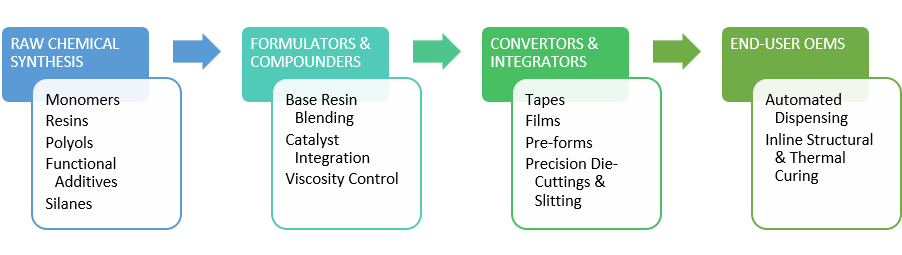
- 1.2 Value Chain Mapping: Raw chemical synthesis (monomers, resin precursors) Formulators & Compounders Convertors/OEM Integrators End-Users.
- 1.3 Secular Megatrends Driving Growth:
- Structural lightweighting (replacing rivets/welds with structural bonding).
- Sustainability, bio-based feedstocks, and end-of-life debonding on demand.
- Miniaturization and thermal management in advanced electronics.
- Supply chain consolidation and regulatory compliance (REACH, VOC restrictions).
Section 2: Technical Foundations – Formulations, Chemistries & Mechanics
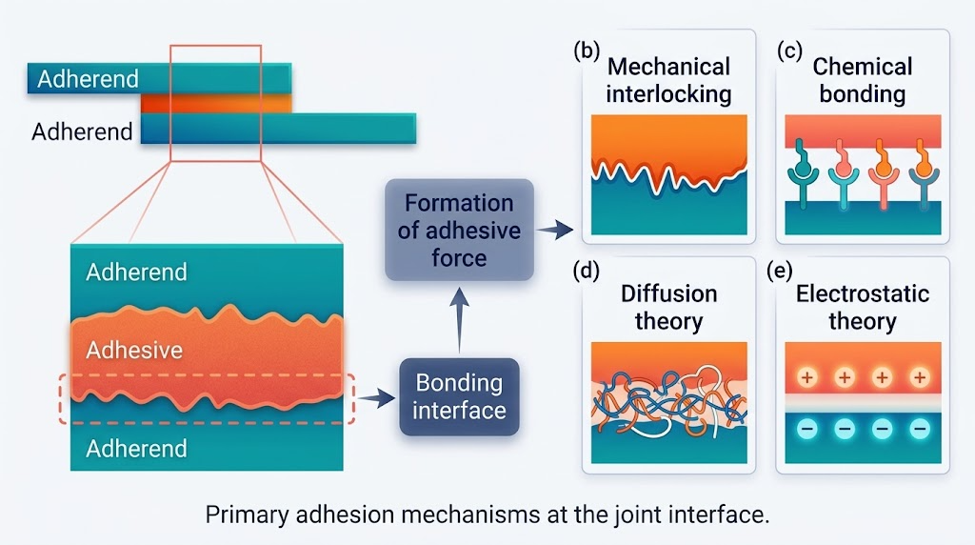
- 2.1 Adhesion Mechanics & Physics: Surface energy, wetting, mechanical interlocking, interdiffusion, and chemical/covalent bonding mechanisms.
- 2.2 Major Chemical Classifications:
- Epoxies: Structural load-bearing, chemical resistance, two-part vs. one-part heat-cured.
- Polyurethanes (PU): High elasticity, impact resistance, moisture-cured, hot-melt PUs (HMR).
- Acrylics & Cyanoacrylates: Rapid-cure, methyl methacrylate (MMA), structural acrylics, pressure-sensitive acrylics.
- Silicones & Modified Polymers (MS Polymers): Extreme thermal stability, environmental sealing, stress dissipation.
- Hot-Melts & Rubber-Based: EVA, polyolefins (APAO/mPO), styrenic block copolymers (SBCs).
- 2.3 Processing & Curing Technologies: Thermosetting (heat/moisture/catalyst), UV/dual-cure light activation, pressure-sensitive (PSA), and solvent/water-evaporative drying.
Section 3: Competitive Landscape & Market Leaders
- 3.1 Global Tier-1 Pure-Play & Diversified Majors: Henkel Adhesives, H.B. Fuller, Arkema (Bostik), Sika AG, 3M, Dow, Huntsman, Wacker Chemie.
- 3.2 Regional Champions & Specialized Innovators: Pidilite (India), Avery Dennison (PSAs), Nitto Denko, Lord Corporation (Parker Hannifin).
- 3.3 M&A Trends & Consolidation Dynamics: Roll-up strategies of high-margin niche formulators by chemical conglomerates.
Section 4: High-Value Industry Deep Dives
Detailed breakdown across key sectors, high-value subsectors, and critical application domains.
4.1 Automotive & Transportation
- Subsectors: Electric Vehicles (EVs) & Battery Packs, Internal Combustion Engine (ICE) Assembly, Commercial Transit & Aerospace.
- High-Value Application Domains:
- EV Battery Packs: Thermal Interface Materials (TIMs), cell-to-pack structural potting, flame-retardant structural adhesives.
- Multi-Material Lightweighting: Aluminum-to-composite structural bonding (reducing spot welding).
- Glass & Windshield Encapsulation: Moisture-cured PU direct glazing.
4.2 Electronics, Semiconductors & Micro-Assembly
- Subsectors: Semiconductor Packaging, Consumer Electronics (Smartphones/Wearables), Displays & Sensors.
- High-Value Application Domains:
- Die-attach adhesives, electrically conductive adhesives (ECAs), anisotropic conductive films (ACF).
- Underfills & Encapsulants: Flip-chip underfills, wafer-level packaging, liquid optically clear adhesives (LOCA) for touch displays.
- Precision potters & conformal coatings for PCB environmental insulation.
4.3 Building, Infrastructure & Renewable Energy
- Subsectors: Architectural Glass & Structural Glazing, Flooring/Tile Mortars, Wind Energy & Solar PV.
- High-Value Application Domains:
- Wind Turbine Blade Assembly: Epoxy and vinyl ester structural bonding pastes for multi-meter root joints.
- Photovoltaic Modules: Edge sealants and junction box silicone adhesive potting.
- Structural Silicone Glazing (SSG): Glass-to-curtain wall architectural load bearing.
4.4 Medical, Healthcare & Life Sciences
- Subsectors: Medical Devices, Wearable Diagnostics, Surgical & Wound Care.
- High-Value Application Domains:
- Skin-contact PSAs: Gentle-to-skin silicone and acrylic gels for long-wear wearable sensors.
- Surgical Tissue Glues: Cyanoacrylate and fibrin-based bio-adhesives for internal/external wound closure.
- ISO 10993/USP Class VI Light-Cure Adhesives for needle bonding, catheter assembly, and fluidics.
4.5 Advanced Packaging & Converting
- Subsectors: Flexible Laminates, E-commerce Logistics Packaging, Paper Converting.
- High-Value Application Domains:
- Solventless food-grade laminating adhesives for barrier pouch flexible packaging.
- High-speed hot-melt case sealing (metallocene polyolefins) operating under extreme temperatures.
Section 5: Future Horizon – Next-Gen Materials & Strategic Outlook
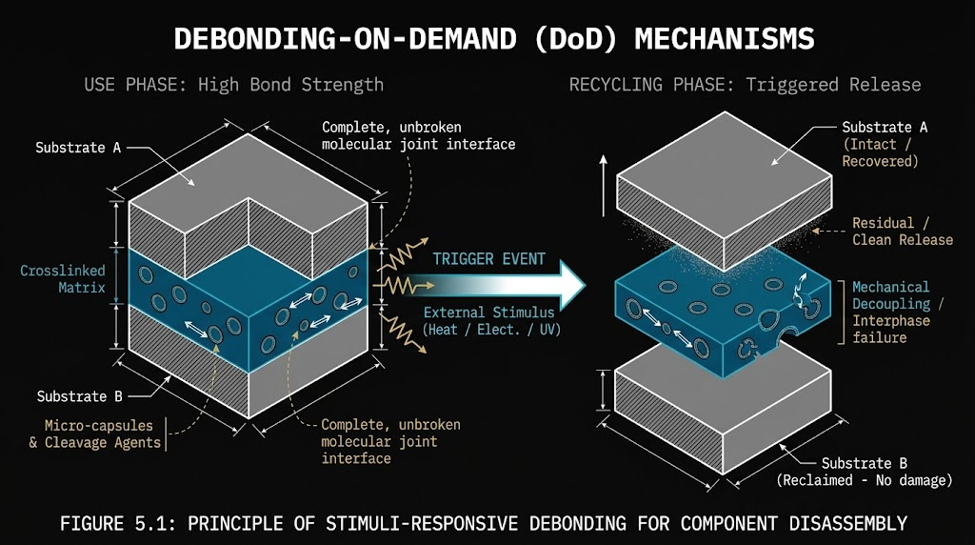
- 5.1 Debonding-on-Demand (DoD): Thermally, electrically, or chemically triggered release mechanisms enabling circular economy recycling.
- 5.2 Bio-based & Renewable Feedstocks: Replacing petrochemical polyols/resins with lignin, cellulose, vegetable oil, and marine-derived materials.
- 5.3 Smart Adhesives: Self-healing networks and embedded diagnostic sensors for structural health monitoring.
Section 1: Executive Overview & Macro Industry Dynamics
The global adhesives and functional bonding industry represents an estimated $80B–$90B market, serving as a expanding enabler across modern manufacturing and assembly. Adhesives have long been regarded as a commodity material has not shifted towards advanced packaging technologies which enable multifaced and multifunctional applications. For example, a typical joining technology, such as a screw, can perform one function: joining. An adhesive, can perform multiple functions: joining and sealing and moreover polymeric functional properties such as thermal heat dissipation, UV protection, optical light pass-through, etc. The adhesives industry has undergone a structural transformation. Today, adhesives operate as precise structural, thermal, and electrical functional materials that often dictate the performance boundaries of end-use hardware ranging from EV battery architectures to semiconductors.
1.1 Market Sizing, Growth Trajectories & Regional Dynamics
The global market is expanding at a steady 4.5–5.5% CAGR, driven increasingly by value-density growth where high-performance, low-volume formulations command significant price premiums over legacy commodity products. With increasing understanding of polymeric systems, we can increase strength with less and less material application which further reduces product sizes. The iPhone and other phone brands utilize adhesive technologies to perform multiple functions while simultaneously reducing product size.
Volume vs. Value Disconnect
Standard pressure-sensitive adhesives (PSAs), packaging hot-melts (EVA, APAO), and basic construction sealants account for over 60% of total tonnage but yield tight, low-margin returns susceptible to petrochemical raw material swings. Advanced structural adhesives (toughened epoxies, acrylics, polyurethane hybrids) and functional adhesives (electrically conductive, thermal interface materials, optical clarity resins) capture a disproportionate share of industry profit pools. These specialized chemistries are priced on performance-value capture (e.g., dollars per gram or dollars per dispense cycle) rather than raw volume cost. Often times the price and formulation are highly disconnected due to the competitive nature of both the adhesive and end-product use markets. For example, Apple does not want their adhesive formulations for crystal clear opacity of their bonded display panels (on an iPhone) to be replicated by competitors. Interestingly, despite Apple and numerous American headquartered companies using adhesives, their application region, shown below, often falls within the APAC sector due to location of manufacturing.
| Region | Dominant Focus Areas | Strategic & Growth Drivers |
| Asia-Pacific (APAC) | Semiconductor packaging, consumer electronics, solar/battery manufacturing, high-volume consumer goods. | Manufacturing Dominance: APAC accounts for >45% of global volume demand. Growth is anchored by localized supply chains in China, South Korea, Taiwan, and Vietnam, along with massive investments in battery gigafactories. |
| North America | Aerospace/defense structural bonding, automotive lightweighting, medical devices, advanced packaging. | High-Value R&D Hub: Strong focus on high-margin, highly spec’d structural and medical-grade formulations. Driven by reshoring, EV platform transitions, and stringent regulatory standards. |
| Europe | Sustainable/bio-based formulations, automated automotive assembly, premium structural engineering, wind energy. | Regulatory & Circular Economy Leader: Characterized by strict environmental standards (REACH, low-VOC mandates). Leads the transition toward debonding-on-demand and bio-derived feedstocks. |
1.2 Value Chain Mapping & Structural Economics
The value chain spans four primary nodes, each defined by distinct capital intensity, R&D requirements, and margin profiles. Upstream Chemical Synthesis (Monomers & Resins) companies include Dow, BASF, Covestro, Evonik, Wacker. These companies have high capital expenditure (Capex), low-to-medium margins, and commodity risk. They focus on producing foundational building blocks such as epoxy resins (DGEBA), polyols, isocyanates, acrylic monomers, silicone precursors, and functional additives (silanes, tackifiers). Formulation & Specialty Compounding (The Core Value Engine) companies include pure-play formulators and diversified specialty chemical majors such as Henkel, H.B. Fuller, Arkema/Bostik, Sika, 3M, and Huntsman. They focus on high research intensity and customer stickiness. Formulators modify polymer backbones with catalysts, toughening agents, fillers, and rheology modifiers to meet rigorous OEM design specifications (e.g., cure time, shear/peel strength, glass transition temperature ( ), outgassing thresholds). Next, we have the converting & precision formatting companies including specialty convertors and tape manufacturers such as Avery Dennison, Nitto Denko, Tesa, and other specialized die-cutters. They focus on converting bulk liquid or solid formulations into precise application formats—transfer tapes, pressure-sensitive films, micro-encapsulated beads, or multi-component cartridge systems designed for automated line integration. Finally, you have the Downstream OEM Integration & End-Users that are often automotive OEMs, tier-1 suppliers, electronics manufacturers, aerospace primes, medical device builders – look at the make up of the S&P 500 and NASDAQ for a list of the OEM. This final category focuses on long qualification cycles (12–36 months). Once a specialized formulation is specified into an OEM platform (e.g., an EV chassis or medical device line), switching costs become prohibitively high, creating long-term, high-margin revenue streams for specified formulators.
1.3 Secular Megatrends Reshaping the Industry
Structural Lightweighting & Multi-Material Joining
Traditional mechanical fasteners (bolts, rivets, spot welds) introduce stress, increase weight, and are inherently incapable of effectively joining dissimilar materials with vastly different thermal expansion coefficients (e.g., carbon fiber-reinforced polymers to aluminum, or glass to composite). A classic case study of the failure of mechanical fasteners attempting to join dissimilar materials is the Titanic. Advanced structural adhesives distribute stress uniformly across the joint area, eliminate fatigue points, prevent galvanic corrosion, and unlock weight reductions critical for fuel efficiency and electric vehicle range expansion.
Thermal Management & Miniaturization
As electronics and battery architectures increase in power density while decreasing in physical footprint, thermal dissipation becomes a primary failure mode. Functional adhesives are increasingly required to serve dual roles that provide structural joint integrity while acting as Thermal Interface Materials (TIMs) or Electrically Conductive Adhesives (ECAs) filled with ceramic or metallic micro/nano-particles.
Sustainability, Regulations & Debonding-on-Demand
Regulatory frameworks (e.g., EU REACH, strict VOC limits, PFAS restrictions) are forcing a phase-out of traditional solvent-borne formulations, hazardous cross-linkers, and persistent fluoropolymers. Simultaneously, the push toward a circular economy has exposed a fundamental contradiction in adhesive engineering: traditional adhesives are designed never to fail, making recycling, disassembly, and component recovery nearly impossible. An innovation that the semiconductor utilized heavily to force consumers to purchase new products rather than upgrading components (old school PC market). This mismatch is driving rapid innovation in debonding-on-demand (DoD) technologies. Adhesives engineered to maintain high strength throughout product life, but quickly release when triggered by targeted thermal, electrical, or chemical stimuli. No one has effectively accomplished this at meaningful scale.
Section 2: Technical Foundations – Formulations, Chemistries & Mechanics
2.1 Adhesion Mechanics & Physics
Adhesion is rarely governed by a single mechanism; rather, structural joint integrity depends on the synergistic interaction of thermodynamics, micro-topology, polymer chain kinetics, and interfacial molecular bonding. Understanding these core physical and chemical drivers is essential for engineering high-performance formulations tailored to challenging substrates.
Surface Free Energy, Wetting & Thermodynamics
Before any physical or chemical bond can form, a liquid adhesive must achieve intimate molecular contact with the solid substrate (the adherend). This thermodynamic process is dictated by Surface Free Energy (SFE) and Wetting Dynamics. Intimate contact requires the liquid adhesive to spread spontaneously across the substrate surface. The thermodynamic equilibrium is governed by Young's relation:
where:
is the solid-vapor surface free energy (substrate surface energy).
is the solid-liquid interfacial energy.
is the liquid-vapor surface tension of the un-cured adhesive.
θ is the contact angle.
Thermodynamic Rule for Spontaneous Spreading
Spontaneous wetting () occurs when the surface energy of the substrate exceeds the surface tension of the adhesive formulation (). High-energy substrates (metals, glass, ceramics; ) wet easily. Low-surface-energy (LSE) polymers like polyolefins (polypropylene, polyethylene; ) or fluoropolymers (PTFE; ) resist liquid spreading, requiring chemical surface pretreatments (corona, plasma, flame, or silane priming) to elevate prior to adhesive application.
Mechanical Interlocking & Surface Micro-Topology
Mechanical interlocking operates on a macroscopic to microscopic scale. When a liquid formulation wets a porous or roughened surface, it flows into micro-scale asperities, crevices, and pores. Upon curing or solidification, the polymer forms physical anchor points that resist shear and tensile separation. Micro-abrasion or chemical etching increases the effective interfacial surface area, providing more contact sites for molecular interaction. The rate at which an uncured adhesive penetrates micro-pores is governed by capillary pressure and liquid viscosity. If an adhesive cures or undergoes gelation too quickly before full pore penetration occurs, air pockets are trapped at the interface, serving as high-stress concentration sites for premature failure.
Interdiffusion Theory (Chain Entanglement)
Dominant in solvent-welding and thermoplastic bonding, interdiffusion occurs when polymer chains from the adhesive and a compatible polymer substrate diffuse across the interface, forming an entangled interphase region. Requires mutual thermodynamic compatibility (matching solubility parameters) and sufficient polymer chain mobility (operating above the glass transition temperature). The penetration depth of polymer chains across the interface scales with time and the diffusion coefficient (D):
Over time, this mutual diffusion blurs the distinct physical boundary between adhesive and substrate, converting a sharp interface into a gradient interphase with high fracture toughness.
Chemical & Covalent Bonding Mechanisms
While physical forces (van der Waals interactions, dipole-dipole hydrogen bonding) provide initial tack and assembly strength, high-performance structural joints rely on primary chemical bonds across the interface. Covalent bonds (200-800 kJ/mol) provide the highest thermal and environmental durability. Formulations are engineered with specific functional groups designed to react directly with surface hydroxyl or oxide groups present on substrates (e.g., reactive displays on treated aluminum or steel). Organofunctional silanes () serve as hybrid chemical bridges. The hydrolyzable alkoxy groups (--OR') form covalent siloxane bonds (Si--O--Substrate) with inorganic surfaces (glass, metals), while the organofunctional tail (R—amino, epoxy, vinyl, or methacrylate) co-cures into the organic adhesive matrix, creating a moisture-resistant bridge.
2.2 Major Chemical Classifications
The choice of adhesive chemistry dictates every functional boundary of a joint—including mechanical strength, thermal stability, flexibility, environmental durability, and processing speed. Modern formulators tune base polymers through backbone selection, resin-to-hardener stoichiometry, catalyst choices, and filler package loading.
Epoxies (EP)
Epoxy formulations are the premier choice for high-strength, structural load-bearing applications. They cure via step-growth polymerization through the ring-opening of oxirane (epoxide) groups, yielding a highly crosslinked thermoset matrix with minimal cure shrinkage ( ). Standard resins are based on Diglycidyl Ether of Bisphenol A (DGEBA) or Bisphenol F (DGEBA/F), novolacs for higher temperature resistance, and cycloaliphatic epoxies for UV stability and electrical applications. Common crosslinkers include aliphatic/aromatic amines, polyamides, anhydrides, and dicyandiamide (DICY) for latent one-part systems.
Methyl Methacrylate (MMA) Free Radical Polymerization
Common properties include exceptional tensile/lap-shear strength (20--40+ MPa), high glass transition temperature ( up to ), minimal creep under static load, and superb resistance to fuels, solvents, and moisture. Unmodified epoxies are inherently brittle with low impact and peel strength. Formulators incorporate Core-Shell Rubber (CSR) nanoparticles, carboxyl-terminated butadiene acrylonitrile (CTBN) liquid rubbers, or reactive thermoplastic tougheners to form phase-separated micro-domains that arrest crack propagation without sacrificing heat resistance.
Polyurethanes (PU)
Polyurethanes are defined by the reaction of poly-functional isocyanates (-NCO) with hydroxyl-terminated polyols (-OH). The balance between hard segments (isocyanate-chain extender reactions) and soft segments (flexible polyol backbones) allows formulators to tune properties from ultra-flexible elastomeric sealants to rigid structural adhesives. Isocyanates are dominated by Methylene Diphenyl Diisocyanate (MDI) and Toluene Diisocyanate (TDI) for structural formulations, and Isophorone Diisocyanate (IPDI) for non-yellowing, light-stable systems. Polyols typically range from polyethers (hydrolysis-resistant) to polyesters (high mechanical strength and thermal resistance). Isocyanate-terminated prepolymers react with ambient atmospheric moisture generating an unstable carbamic acid that breaks down into carbon dioxide gas and a reactive primary amine, which subsequently crosslinks remaining isocyanates. Polyol and isocyanate parts mix directly at application, curing independent of ambient humidity and without off-gassing, preventing void formation in thick bondlines. The product is typically characterized by excellent impact toughness, dynamic fatigue resistance, cold-temperature flexibility (down to -), and superior stress-dissipation when joining substrates with mismatched thermal expansion coefficients (e.g., glass-to-aluminum).
Acrylics & Cyanoacrylates
Acrylic chemistry relies on free-radical addition polymerization of acrylate or methacrylate monomers, providing rapid cure speeds and forgiving surface preparation requirements. Methyl methacrylate (MMA) reaction mechanisms are typically redox-initiated (e.g., benzoyl peroxide + tertiary amine accelerator) free-radical polymerization. Key advantages include high tolerance for unprepared, slightly oily metal or plastic surfaces. MMAs can etch through surface oils and establish strong bonds with low-energy plastics (like ABS, polycarbonate, and polyolefins when paired with specialized organoborane initiators). Cyanoacrylate (“super glues”) reaction mechanisms are typically anionic polymerization triggered instantly by trace moisture or surface nucleophiles (e.g., hydroxide ions, ) on substrate surfaces. Key advantages include fixture times in seconds; ideal for small-footprint precision assembly (medical devices, small electronics) and limitations include poor gap-filling capacity, low impact/peel strength, susceptibility to blooming (white chlorosilane/cyanoacrylate monomer vapor deposition around the joint), and moisture degradation at elevated temperatures.
Silanes
Silicone adhesives feature an inorganic siloxane backbone (-Si-O-Si-) bonded to organic side groups (typically methyl or phenyl), providing extreme thermal, optical, and environmental stability. Silicone adhesives typically cure via condensation. Moisture-cured systems releasing volatile byproducts (acetic acid, oximes, or alkoxy) during crosslinking. Hydrosilylation reaction between vinyl-functional silicones and silicon-hydride (Si-H) crosslinkers. Cures rapidly without byproducts or volume shrinkage, ideal for deep-section potting. Operating range from to +, exceptional UV/weathering resistance, low surface energy, and electrical insulation. Silyl-Modified (SMP / MS Polymers) hybrid polymers featuring a polyether or polyurethane backbone terminated with hydrolyzable silane groups. Advantages include the paintability, non-staining, and bubble-free curing of polyurethanes with the UV and environmental durability of silicones, entirely free of unreacted isocyanates.
Hot-Melts & Rubber-Based Adhesives
Hot-melt adhesives are thermoplastic formulations applied in a molten liquid state that gain green strength rapidly upon cooling and thermal crystallization. The four common polymers include Ethylene-Vinyl Acetate (EVA), legacy hot-melt base for packaging and paper converting; cost-effective with moderate temperature limits; Polyolefins (APAO & Metallocene mPO), high thermal stability, clean running (no charring in dispensing equipment), superior low-temperature performance, and lower density than EVA; Styrenic Block Copolymers (SBCs - SBS, SIS, SEBS), foundational polymers for Pressure-Sensitive Adhesives (PSAs), building permanent tack when combined with hydrocarbon tackifying resins and plasticizers; and Reactive Polyurethane Hot-Melts (POR / PUR), applied hot like standard thermoplastics to provide instant green strength, but subsequently react with ambient moisture over 24–48 hours to form an irreversible, crosslinked structural thermoset network with high heat and chemical resistance.
| Chemistry | Primary Strengths | Main Limitations | Typical Lap-Shear Range |
| Epoxy (2K / 1K) | High tensile/shear strength, low creep, excellent chemical/heat resistance. | Brittle without tougheners, slow cure (unless heated), strict mixing ratios. | |
| Polyurethane (PU) | High elasticity, dynamic fatigue resistance, good low-temp flexibility. | Moisture-sensitive uncured, lower max temperature limit ( ). | |
| MMA Acrylic | Fast fixture, bonds oily metals and difficult plastics, high peel strength. | Strong odor, flammable, exothermic cure in thick bondlines. | |
| Silicone (RTV) | Extreme thermal range ( ), UV inert, high elongation. | Low lap-shear strength, unpaintable, potential silicone migration/contamination. | |
| PUR Hot-Melt | Instant green strength, crosslinks into structural bond, solvent-free. | Requires heated dispensing equipment, limited open time. |
2.3 Processing & Curing Technologies
A high-performance formulation is only as good as its execution on the factory floor. The transition of an adhesive from a fluid or tacky solid into an engineered interphase depends entirely on the crosslinking chemistry, thermal history, and activation mechanics. Selection of the curing technology directly dictates assembly takt times, capital expenditure for line integration, and overall joint reliability.
Thermosetting (Thermal, Moisture & Catalytic Activation)
Thermosetting crosslinking transforms linear or branched resin precursors into three-dimensional, insoluble polymer networks through covalent bond formation. Thermal curing systems use 1K Heat-Cured Systems which utilize latent, micro-encapsulated, or chemically blocked catalysts (e.g., dicyandiamide/DICY in 1K epoxies) that remain unreactive at room temperature but instantly unblock or melt at elevated temperatures (). This eliminates automated meter-mix-dispense equipment complexity, though it demands energy-intensive bake ovens and introduces thermal expansion stress on sensitive assemblies; or Induction & Infrared (IR) Heating which use to selectively heat metallic or carbon-fiber substrates directly via electromagnetic induction, accelerating crosslinking locally in seconds without heating the entire structure.
Moisture curing systems dependent on ambient relative humidity (RH≥40--50) diffusing into the bondline. Curing kinetics are governed by Fickian moisture diffusion through the polymer matrix. The core limitation with moisture curing systems include curing speed drops exponentially with increasing bondline thickness. Thick sections risks "skinning over" while leaving uncured, liquid cores underneath, making moisture cures unsuited for deep-potting applications without secondary cure mechanics.
Catalytic 2K Meter-Mix Dispensing physical segregation of reactive components (Part A resin, Part B hardener/catalyst) until dynamic or static mixing immediately prior to application. Curing relies purely on stoichiometry and intrinsic chemical kinetics, making it fully independent of atmospheric humidity or line-of-sight light access.
UV & Dual-Cure Light Activation formulations leverage specific wavelengths of electromagnetic radiation to trigger instantaneous photo-polymerization, providing sub-second fixture times essential for high-throughput micro-assembly.
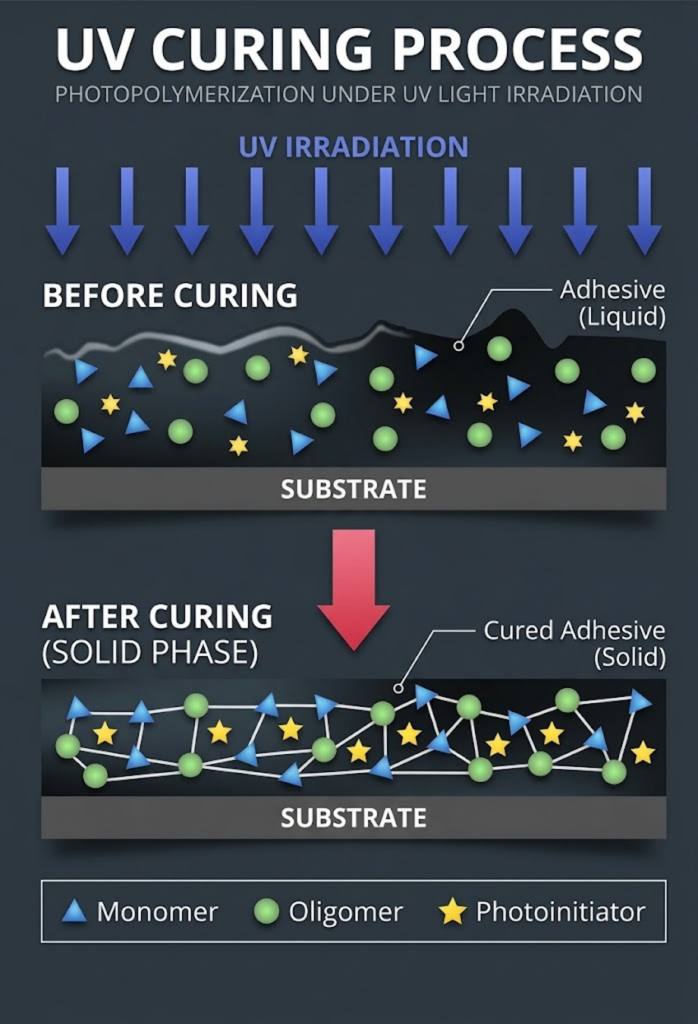
Photo-Initiator Dynamics
Photoinitiators are typically free radical UV curing or cationic UV curing systems. Free Radical UV Curing is where UV light absorbs into photo-initiators (e.g., acylphosphine oxides), cleavage generates free radicals, initiating rapid acrylic double-bond addition polymerization. Highly susceptible to oxygen inhibition at surface layers, which leaves a tacky finish unless cured under inert nitrogen blankets or targeted with specific short-wavelength UV-C. Cationic UV Curing is where photo-acid generators (PAGs) to release superacids upon UV exposure, initiating ring-opening polymerization of cycloaliphatic epoxies or vinyl ethers. The key advantage is that it is immune to oxygen inhibition, lower volume shrinkage, and continues to post-cure in the dark after light exposure ceases ("shadow cure"). Industrial assembly has shifted rapidly from traditional broad-spectrum mercury arc lamps (250--450 nm) to targeted UV-LED arrays (typically 365 nm, 385 nm, or 405 nm). Some of the benefits include lower heat output (protecting temperature-sensitive plastic or electronic components), lower operational power consumption, instant ON/OFF control without warm-up cycles, and longer emitter lifetimes (>20,000 hours). Often times Dual-Cure Mechanics (Overcoming Shadowed Zones) systems are used when bonding opaque components (e.g., metal-to-black PCB substrates) or if light cannot reach shadowed regions of the joint. Dual-Cure Formulations pair an instant UV surface fixture mechanism with a secondary, slow-acting secondary cure—such as moisture-cure, heat-activation, or anaerobic mechanism—ensuring complete crosslinking across hidden areas.
Pressure-Sensitive Adhesives (PSAs) & Physical Drying Systems
Non-reactive or physically setting systems form bonds through physical state changes rather than chemical crosslinking, providing unique advantages in converting and continuous web assembly.
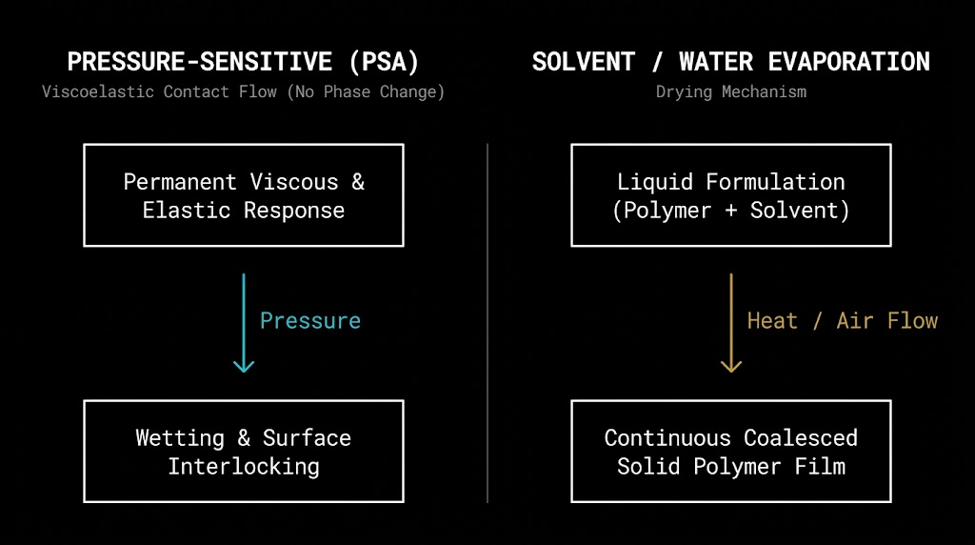
The last two adhesive types include Pressure-Sensitive Adhesives (PSAs) and Solvent & Water-Evaporative Drying. PSAs are formulated to remain permanently tacky at room temperature in a solid, solvent-free state. PSAs do not undergo a phase change (curing or freezing); instead, bond formation occurs purely by applying light external pressure, causing the viscoelastic polymer matrix to flow into surface irregularities. They have an interesting rheological balance and are engineered via the Dahlquist criterion—stating that for an adhesive to exhibit spontaneous tack, its creep compliance or storage modulus (G') at application temperature must be less than 3 at 1 Hz. Solvent & Water-Evaporative Drying adhesives are polymers (e.g., natural rubber, synthetic latex, acrylic emulsions, polychloroprene) are dissolved in organic solvents or dispersed in water carriers. The bonding process uses the liquid carrier evaporates, polymer particles coalesce into a continuous, cohesive solid film. The Industry Phase-Out solvent-borne systems are increasingly restricted globally due to high Volatile Organic Compound (VOC) emissions, fire risks, and worker exposure safety regulations, forcing a rapid market migration toward 100% solids, hot-melt, or waterborne latex alternatives.
Section 3: Competitive Landscape & Market Leaders
The global adhesives market is structurally fragmented at the volume level, yet highly consolidated at the top tier of high-value, engineered formulations. A small group of multi-billion-dollar specialty chemical conglomerates control key intellectual property, global OEM specification approvals, and high-throughput automated dispensing partnerships. Concurrently, a secondary tier of specialized pure-plays dominates high-margin market segments—such as pressure-sensitive tapes, semiconductor encapsulants, and structural construction sealants.
3.1 Global Tier-1 Pure-Play & Diversified Majors
Henkel Adhesive Technologies stands as the undisputed global heavyweight, generating over €10.6B ($11.5B+) in annual revenue—accounting for roughly 50% of the Henkel Group's total sales—and leading the industry in total volume, portfolio breadth, and geographic footprint. Its core portfolio spans iconic brands like Loctite (engineering threadlockers, cyanoacrylates, structural acrylics, and epoxies), Technomelt (advanced hot-melts), Teroson (automotive body, acoustic, and structural bonding), and Bergquist (thermal interface materials for electronics). Henkel's strategic moat rests on deep specification lock-in across automotive platforms, consumer electronics assembly, and heavy industrial machinery, reinforced by a global network of technical application centers.
In the construction and industrial joining domain, Sika AG leads with net sales of ~CHF 11.2B ($12.5B+), where adhesives, sealants, and acoustic damping drive a core share of profits. Sika specializes in structural polyurethane and silyl-modified polymer (SMP) direct glazing for automotive and rail transit (Sikaflex), as well as structural silicone glazing and elastomeric bonding for commercial architecture (Sikasil). Its moat stems from unrivaled penetration across civil engineering, commercial building, and transit OEMs, expanded significantly through major acquisitions like MBCC Group.
Arkema's specialty adhesives division, Bostik, generates ~€2.7B ($3.0B) annually by focusing on advanced flexible packaging laminates, hygienic non-wovens, high-performance hot-melts, and structural construction adhesives. Bostik derives a unique competitive advantage from parent company Arkema’s vertical integration into upstream specialty monomers (polyamides, thiochemicals, acrylics), enabling tailored molecular design from basic polymer synthesis down to the final formulation.
H.B. Fuller operates as a pure-play adhesive manufacturer generating ~$3.5B in annual net revenue. The company maintains global leadership across hygiene/non-woven disposables, industrial packaging converting, durable product assembly, and specialized EV battery thermal management coatings. Operating without the corporate overhead of parent chemical divisions allows H.B. Fuller to maintain an agile, customer-centric engineering model that delivers rapid formulation customization for both mid-market and enterprise manufacturers.
Diversified giant 3M Company addresses the market through its Safety & Industrial and Electronics business groups, deploying flagship platforms like VHB structural foam tapes, Scotch-Weld structural adhesives, and precision thermal management pads. 3M’s moat relies on deep multi-disciplinary R&D expertise across micro-replication, precision pressure-sensitive adhesive (PSA) formulation, film extrusion, and surface modification technologies.
Finally, silicon-based chemistries are anchored by Dow Chemical and Wacker Chemie. Dow dominates high-reliability optical encapsulation, die-attach adhesives, and silicon-based thermal management gels (DOWSIL) across consumer electronics and EV power modules. Wacker Chemie serves as a parallel force, specializing in organo-functional silicone resins, silane-terminated polyethers (GENIOSIL), and high-purity thermal interface pastes engineered for harsh operating environments.
3.2 Regional Champions & Specialized Innovators
Outside the top-tier conglomerates, specialized market champions command exceptionally high margins by focusing on specific geographic hubs, application formats, or high-value niches:
| Company | Key Geographic & Product Niche | Strategic Differentiation |
| Pidilite Industries | India & South Asia (Consumer, Woodworking, Construction) | Near-monopolistic brand equity in consumer/crafts (Fevicol) paired with a deep distribution moat across emerging South Asian construction markets. |
| Avery Dennison | Global Leader in PSAs, Medical Tapes & Labeling Stock | Master-roll coaters and converters of pressure-sensitive acrylics and silicone skin adhesives (Vancive Medical). |
| Nitto Denko & Tesa | East Asia & Europe (Electronics Materials & Industrial Tapes) | Precision optical clear adhesives (LOCA), anisotropic conductive tapes, and semiconductor processing tapes (dicing/wafer mounting). |
| Parker LORD | Aerospace, Defense & Automotive Structural Materials | High-value structural acrylics, elastomeric anti-vibration mountings, and specialized EV battery thermal management coatings. |
3.3 Mid-Market Specialists & High-Precision Innovators
Beyond the multi-billion-dollar conglomerates lies a crucial layer of agile, highly focused mid-market formulators that generate substantial margins by capturing sole-source specifications in high-tech manufacturing where failure is not an option.
A primary benchmark in high-tech micro-assembly is DELO Industrial Adhesives, a German owner-managed innovator generating ~€264M ($285M+) in annual revenue, with nearly 90% derived from international markets across APAC and the Americas. DELO reinvests an extraordinary ~15% of its annual revenue directly back into R&D, focusing technically on high-speed, high-precision light-cured (UV/LED) and dual-curing adhesives engineered for optoelectronics, semiconductor packaging, camera modules, sensors, and automotive electronics. DELO strategically differentiates itself through a integrated system solutions approach—co-engineering the dispensing valve systems, UV-LED curing lamps, and liquid formulations together to guarantee sub-second fixture times and micron-level placement precision on client production lines. This hardware-and-chemistry integration provides deep lock-in across high-density technology hubs, positioning DELO as a sole-sourced development partner for consumer tech giants, optoelectronic chipmakers, and advanced driver-assistance system (ADAS) sensor manufacturers.
Additional Specialized Regional Champions & Niche Leaders
| Company | Revenue / Size Class | Primary Niche & Core Competency | Strategic Moat |
| DELO Industrial Adhesives | ~$285M (€264M) | Optoelectronics, semiconductor die-attach, micro-dispensing, UV dual-cure. | Integrated hardware + chemistry sales; sole-sourced in Tier-1 consumer tech & automotive sensor lines. |
| Pidilite Industries | ~$1.4B | India & South Asian consumer, woodworking, and structural construction markets. | Near-monopolistic brand equity (Fevicol) and massive distribution coverage in fast-growing emerging markets. |
| Avery Dennison | ~$8.4B (Group) | Medical-grade skin contact PSAs, industrial transfer tapes, labelstock converting. | Master-roll high-speed precision coating and skin-friendly silicone/acrylic gel formulations. |
| Nitto Denko & Tesa | $1B+ (Adhesive Units) | Optically Clear Adhesives (LOCA), anisotropic conductive films (ACF), semiconductor dicing tapes. | High-purity cleanroom coating capabilities for display panels, wearables, and micro-electronics. |
| Parker LORD | ~$1B+ (Adhesive Division) | Structural acrylics, elastomeric anti-vibration mounts, EV battery Thermal Interface Materials (TIMs). | Deep qualification footprint across aerospace/defense platforms and automotive tier-1 body-in-white structures. |
3.4 M&A Trends & Consolidation Dynamics
The global adhesives sector undergoes continuous consolidation driven by three distinct structural forces.
First, chemical conglomerates consistently roll up agile, high-margin niche formulators generating $10M to $100M in revenue. This strategy allows majors to directly capture specialized intellectual property in high-growth domains—such as thermal interface materials (TIMs), medical-grade skin contact PSAs, or liquid optically clear adhesives (LOCA)—rather than committing years to internal R&D.
Second, major formulators are actively pursuing supply chain verticalization and backward integration. By strategically acquiring specialized upstream resin, catalyst, or bio-feedstock producers, companies can hedge against raw material price volatility and secure resilient, localized supply lines for critical precursors like bio-based polyols and functional silanes.
Third, tightening global environmental mandates—including EU REACH regulations, PFAS restrictions, and circular economy directives—are driving aggressive inorganic expansion into circular and debondable technologies. Tier-1 players are targeting startups and university spinouts holding key patents in Debonding-on-Demand (DoD), bio-derived tackifiers, and monomer-free or low-VOC chemistry platforms.
Section 4: High-Value Industry Deep Dives
4.1 Automotive & Transportation (EV Batteries, Lightweighting & Direct Glazing)
The automotive industry represents one of the fastest-growing and highest-value markets for advanced functional bonding. As vehicle architectures shift from traditional internal combustion engines (ICE) toward battery electric vehicles (BEVs) and lightweight hybrid platforms, functional adhesives are replacing mechanical fasteners to serve dual roles: primary structural integrity and targeted thermal or electrical management.
EV Battery Pack Adhesive Integration
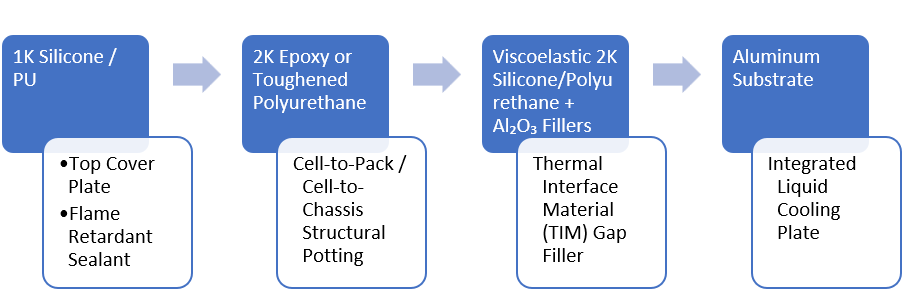
The rapid transition from traditional modular battery packs (Cell-to-Module, C2M) toward integrated Cell-to-Pack (C2P) and Cell-to-Chassis (C2C) architectures has elevated adhesives to core structural elements of the drivetrain.
Within EV battery architecture, Thermal Interface Materials (TIMs) and gap fillers serve a critical functional role: because battery cells generate substantial thermal energy during rapid charging and high-discharge acceleration, 2K liquid-dispensed TIMs bridge microscopic air gaps between lithium-ion cells (prismatic, cylindrical, or pouch) and the aluminum cold plate to ensure efficient heat conduction. Mechanically, these highly filled 2K silicones or polyurethanes are loaded with ceramic particles—such as alumina (), aluminum trihydrate (ATH), or boron nitride (BN)—achieving thermal conductivities ranging from 1.5 to 4.0 W/m⋅K while maintaining high electrical isolation with a dielectric breakdown strength >10 kV/mm.
For structural cell bonding and potting, C2P architectures eliminate intermediate module housings, requiring cells to be bonded directly to the battery pack tray where the adhesive must handle structural road vibration, thermal expansion stresses, and crash-impact loads. These formulations utilize toughened 2K polyurethane and epoxy hybrids designed for high energy absorption and crash resistance, paired with UL 94 V-0 flame-retardant additives to delay thermal runaway propagation between neighboring cells. Finally, for pack enclosure and cover sealing, removable 1K moisture-cure silicones or butyl-rubber hybrid sealants provide IP67/IP69K environmental ingress protection against moisture, road salt, and dirt, while enabling service access for warranty battery repair.
To maximize driving range, automotive OEMs are simultaneously incorporating multi-material Body-in-White (BIW) lightweighting concepts that combine high-strength steel (AHSS), extruded aluminum alloys, magnesium, and carbon fiber-reinforced polymers (CFRP). Adhesives address three pivotal challenges here:
- Galvanic Corrosion Mitigation: Direct contact between dissimilar metals (e.g., aluminum and steel) creates a galvanic couple that accelerates localized corrosion; a continuous structural adhesive layer provides a physical dielectric barrier, eliminating galvanic action across the joint interface.
- Stress Uniformity vs. Spot Welding: Spot welds, rivets, and self-piercing fasteners concentrate mechanical stress around localized puncture sites, leading to premature fatigue cracking under cyclic torsional loads. Continuous adhesive beads distribute mechanical loads across the entire flange area, increasing static shear strength and dynamic fatigue life by up to 300%.
- Crash-Durable Adhesives (CDAs): Formulated as highly modified 1K epoxy systems containing rubber-toughening agents (e.g., core-shell rubber nanoparticles), CDAs are applied on the press line and cured in the e-coat bake oven (). They maintain high tensile lap-shear strength (>30 MPa) under static conditions while exhibiting exceptional impact-peel strength (>30 N/mm) at high strain rates during crash impacts at sub-zero temperatures (down to -).
Direct glazing and automotive glass integration reflect another area where adhesives play a structural role. Automotive glass—including windshields, panoramic roofs, and quarter glass—now functions as a structural shear panel contributing up to 30% of total vehicle cabin torsional rigidity. Applied primarily via high-modulus, fast-curing 1K or 2K polyurethane adhesives (e.g., Sikaflex, Teroson), these joints are safety-critical: during a rollover or front-end collision, the windshield acts as the primary mechanical backstop for passenger airbag deployment, requiring the adhesive to build high green strength quickly to prevent windshield pop-out. Furthermore, because advanced vehicle platforms feature integrated glass antennas for GPS, 5G, and radar, formulations are engineered with low dielectric loss and precise electrical resistivity () to prevent interference with vehicle telematics and sensor arrays.
4.2 Electronics, Semiconductors & Micro-Assembly
In electronics and semiconductor assembly, adhesives represent high-value-density functional materials where margins are tied directly to yield optimization and thermal reliability. As chip architectures migrate toward 2.5D/3D heterogeneous integration and consumer devices demand tighter form factors, specialized adhesives serve as structural anchors, thermal conduits, electrical bridges, and environmental shields.
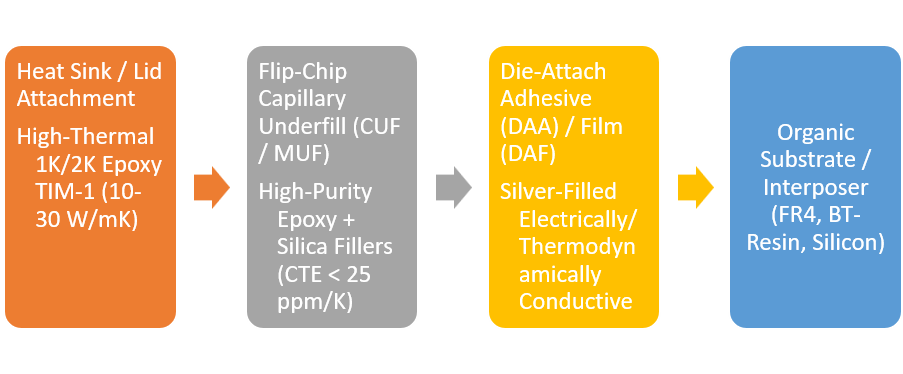
SEMICONDUCTOR & PACKAGING ADHESIVE STACK
Semiconductor Packaging & Advanced Encapsulation
At the chip-level, adhesives protect delicate silicon dies and fine micro-bumps from mechanical fatigue, thermo-mechanical stress, and atmospheric contamination.
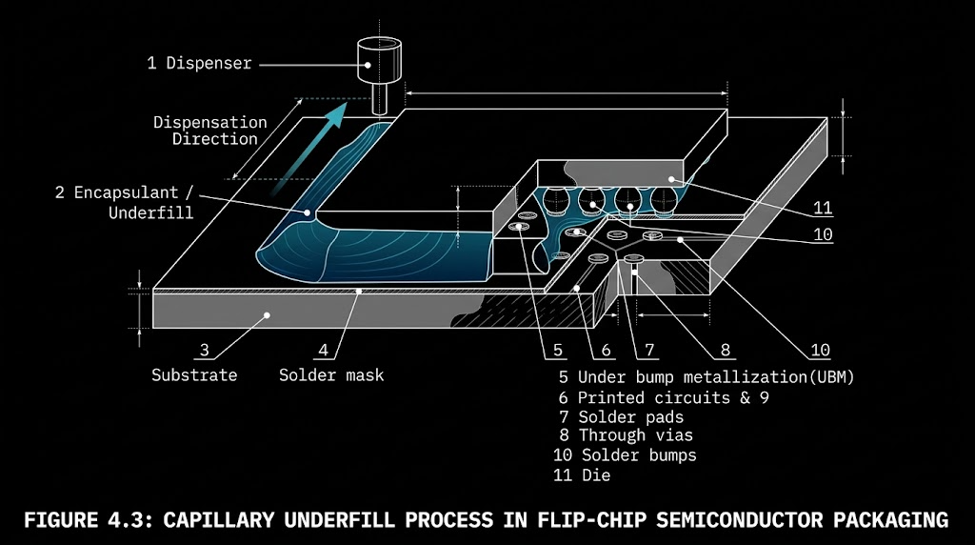
At the chip level, adhesives protect delicate silicon dies and fine micro-bumps from mechanical fatigue, thermo-mechanical stress, and atmospheric contamination. Die-Attach Adhesives (DAA) and Die-Attach Films (DAF) mount silicon dies directly onto lead frames, organic substrates, or interposers, relying on formulations that maintain ultra-low ionics (<10 ppm ,) to prevent wire bond and pad corrosion. These Isotropic Electrically Conductive Adhesives (ECAs) are loaded with 70--80 wt micron-sized silver (Ag) flakes in a toughened epoxy-acrylic matrix, delivering electrical resistivity below and thermal conductivity up to 10--50 W/m⋅K. Meanwhile, flip-chip underfills (including capillary CUF, non-conductive NCF, and molded MUF) address thermodynamic challenges where mismatches in the Coefficient of Thermal Expansion (CTE) between silicon (2.6 ppm/K) and organic substrates (15--18 ppm/K) cause severe shear fatigue on solder joints during thermal cycling. Low-viscosity capillary underfill liquid epoxies are jet-dispensed along the die edge and flow under the chip via capillary pressure to encapsulate solder bumps; these formulations are heavily loaded with spherical fused silica () nanoparticles (50--70 wt) to tune the down below 25 ppm/K—matching solder bump dynamics while elevating the glass transition temperature ().
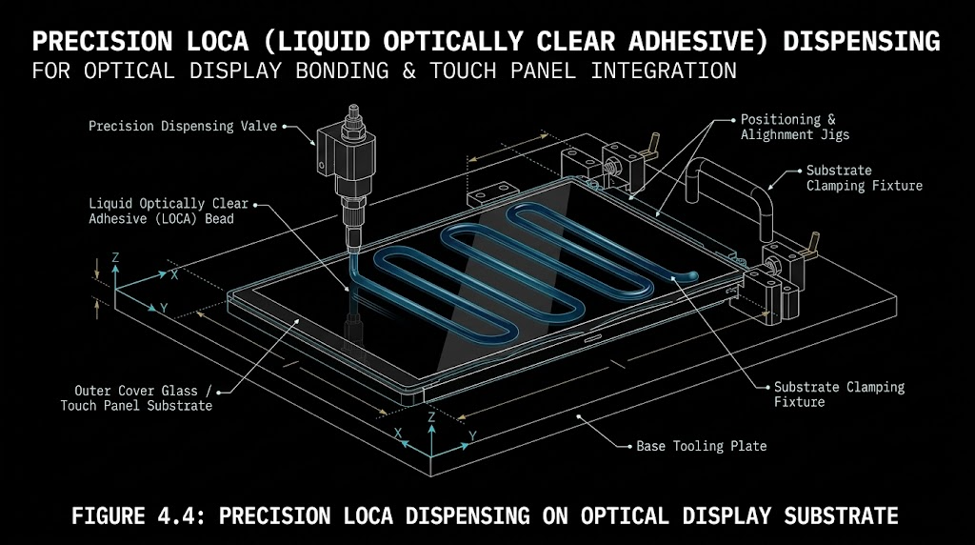
Displays, optoelectronics, and sensor assemblies in modern smartphones, smartwatches, and automotive cockpit displays rely on optically clear and fast-curing formulations to maximize optical throughput and eliminate internal reflections. Liquid Optically Clear Adhesives (LOCA) utilize specialized liquid acrylics or silicones with refractive index matching (n≈1.49--1.51) to minimize light refraction across cover glass-to-touch sensor interfaces, offering refractive transmission >99 with yellowing indices () under UV exposure testing. To eliminate display mura effects caused by volumetric cure shrinkage, LOCA resins leverage soft, low-modulus oligomers that keep volumetric shrinkage under 1.0. For compact camera modules (CCM) and ADAS sensor alignment, active alignment of camera lenses onto CMOS image sensors requires micron-level positioning precision prior to curing. Dual-cure chemistries achieve this by combining rapid UV surface-fixturing (<1 second) to fix lens orientation immediately, followed by low-temperature thermal post-curing () to fully crosslink shadowed regions without damaging heat-sensitive optical plastics.
At the board level, adhesives safeguard surface-mount technology (SMT) components against moisture, corrosive gases, dust, and mechanical shock. Anisotropic Conductive Films (ACF) enable unidirectional conduction for Fine-Pitch Flex-on-Glass (FOG) and Flex-on-Board (FOB) interconnects using a thermoplastic/thermoset resin matrix embedded with a monolayer of nickel-gold conductive micro-spheres (3--5 μm). During thermocompression bonding, the film is squeezed vertically to force conductive particles into contact with opposing pads, establishing z-axis electrical conductivity while remaining electrically insulating along the x-y plane. Additionally, Surface-Mount Adhesives (SMA) and board-level underfills (BLU) utilize fast-curing 1K epoxies applied via high-speed jetting valves (>100,000 dots/hour) to anchor passive components prior to wave soldering. Finally, thin-film (25--125 μm) UV-cured acrylic, silicone, or polyurethane conformal coatings and encapsulants are applied over assembled PCBs to prevent dendritic growth and electrochemical migration in harsh operating environments such as automotive engine bays and industrial controls.
4.3 Building, Infrastructure & Renewable Energy (Wind Turbine Blades, Solar PV, Structural Glazing)
Adhesive bonding in infrastructure and renewable energy must satisfy severe operational parameters: continuous cyclic fatigue, extreme weather exposure, high ultraviolet (UV) radiation, and service lifespans spanning 20 to 30+ years. Replacing mechanical joints with structural adhesives enables stress distribution over large surface areas, protects against environmental degradation, and facilitates the integration of large-scale composite and glass structures.
RENEWABLE ENERGY & STRUCTURAL BONDING APPLICATIONS
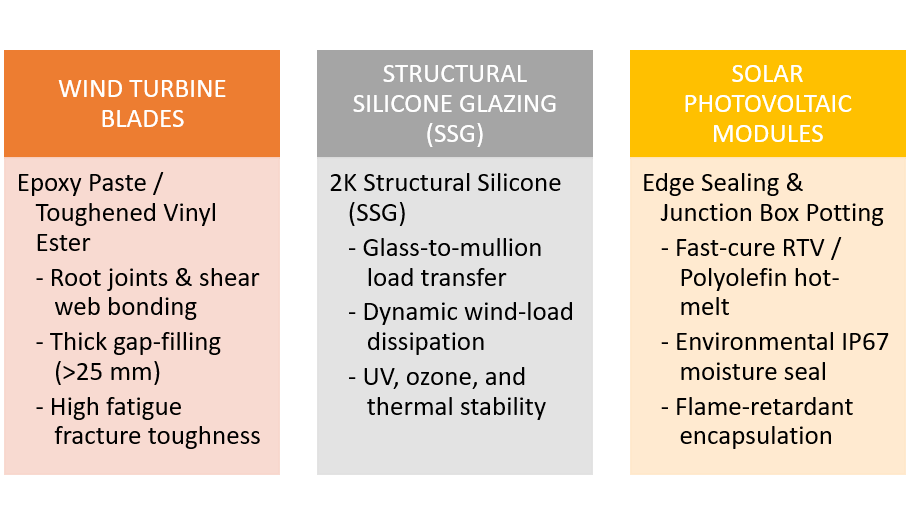
As offshore and onshore wind turbines scale to multi-megawatt capacities, rotor blade lengths routinely exceed 80 to 100+ meters. Because blades are constructed in hollow composite aerodynamic halves, structural adhesives serve as the primary mechanical load-bearing links holding the entire structure together. Structural shear webs and spar caps—the internal backbone handling flexural and torsional loads—are bonded to the glass fiber or carbon fiber-reinforced polymer (GFRP/CFRP) outer shells using high-modulus, two-part structural pastes, primarily toughened epoxies or vinyl esters. Adhesive paste beads are dispensed at immense scales, with thicknesses ranging from 10 mm to over 30 mm. Consequently, formulations must exhibit high sag resistance (thixotropy) during open assembly times (60--180 minutes), followed by controlled exothermic crosslinking to prevent thermal degradation or void formation in thick bondlines. Additionally, blade root joints transfer massive dynamic bending moments directly into the pitch bearing and metallic hub. Adhesives must manage the stark mismatch in flexural modulus between steel root inserts (≈210 GPa) and composite laminates (≈20--40 GPa) under billions of aerodynamic fatigue cycles. To achieve this, formulations incorporate phase-separated tougheners to yield high fracture toughness values (), resisting micro-crack propagation under extreme storm gusts and variable wind loads.
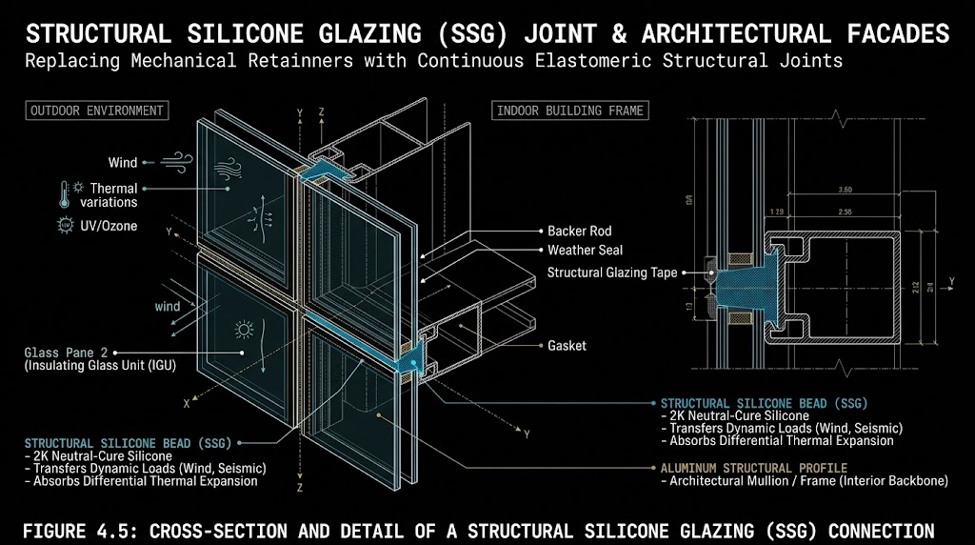
Modern commercial architecture relies on Structural Silicone Glazing (SSG) to create all-glass curtain wall facades, replacing mechanical metal retainers with continuous elastomeric structural joints. The structural silicone joint must continuously transfer high negative and positive wind pressures, snow loads, and seismic movements from the exterior glass pane directly to the aluminum building frame, while absorbing differential thermal expansion. High-modulus, two-part neutral-cure silicones are required due to their inorganic siloxane (Si--O--Si) backbone. Unlike organic polyurethane or acrylic polymers, siloxane bonds resist UV degradation, atmospheric ozone, acid rain, and extreme thermal cycling between and + without embrittlement, chalking, or loss of adhesion over decades of continuous exposure.
In solar energy manufacturing, adhesives and encapsulants are critical to module structural durability, electrical safety, and long-term solar energy conversion efficiency. For cell encapsulation, Ethylene-Vinyl Acetate (EVA) represents the historical standard thermosetting film used to laminate fragile silicon wafers between the top glass cover and protective backsheet. However, next-generation bifacial and n-type TOPCon/HJT solar modules are increasingly transitioning to Polyolefin Elastomers (POE). POE offers superior water vapor transmission resistance (WVTR) and eliminates Potential Induced Degradation (PID) caused by acetic acid off-gassing from standard EVA formulations under high moisture and high voltage stresses. For perimeter frame sealing, fast-curing 1K alkoxy-neutral silicone or modified polyolefin hot-melts are applied along the perimeter profile to seal the laminate edge against moisture ingress. Meanwhile, two-part flame-retardant (UL 94 V-0), highly flowable silicone or polyurethane potting gels encapsulate the electrical bypass diodes inside the junction box, ensuring efficient thermal heat dissipation and reliable IP67/IP68 weatherproofing against environmental ingress.
Structural Silicone Glazing (SSG) Joint
4.4 Medical, Healthcare & Life Sciences (Skin-Contact PSAs, Bio-Adhesives & Biocompatibility)
In medical, healthcare, and life sciences applications, performance failure carries immediate clinical consequences. Medical adhesives operate within tight biological, mechanical, and regulatory boundaries—requiring zero cytotoxicity, predictable wear times, and precise mechanical compliance when bonded to living human tissue, surgical sites, or diagnostic wearable hardware. Typical medical device assembly involves microfluidic systems requiring ISO 10993 / USB Class VI standard compliance, light/UV curing acrylics, and low-outgassing adhesives to maintain sterility.
The continuous proliferation of Continuous Glucose Monitors (CGMs), wearable electrocardiogram (ECG) patches, and advanced wound dressings has shifted skin-contact adhesives from short-term bandages to high-performance, long-wear biological interfaces. Human skin—specifically the stratum corneum—continuously transpires moisture through Trans-Epidermal Water Loss (TEWL) and undergoes natural epidermal cell turnover every 14 to 28 days. Standard industrial PSAs trap moisture, causing tissue maceration, skin stripping, and Medical Adhesive-Related Skin Injury (MARSI) upon removal. To overcome this, acrylic gel PSAs are formulated to balance high initial tack with high moisture vapor transmission rates (), delivering breathable performance that supports 7-to-14-day continuous wear profiles for diagnostic monitors. Alternatively, Soft Silicone Elastomer Gels (SSGs) use crosslinked, low-modulus silicones engineered for delicate or compromised skin (such as neonatal, geriatric, and burn care). SSGs exhibit low peel force and constant adhesion over time, releasing cleanly without removing stratum corneum cells or causing skin trauma. For open wounds, hydrocolloid and hydrogel matrices employ water-absorbing polymeric networks (such as sodium carboxymethylcellulose dispersed in synthetic rubber) that absorb exudate and transform into a cohesive gel, maintaining a moist environment optimal for healing.
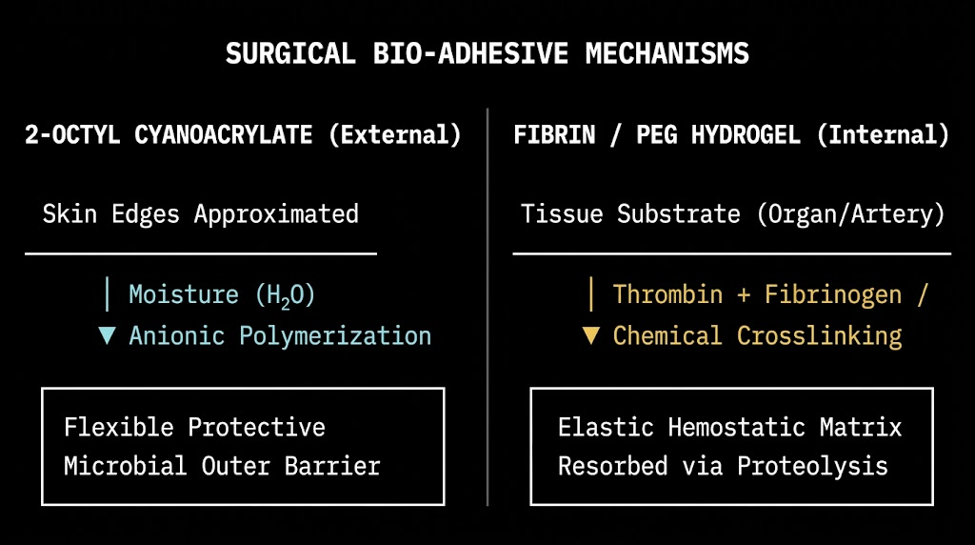
Surgical bio-adhesives and tissue sealants supplement or replace traditional sutures and staples, serving as rapid barriers against fluid and air leaks in soft tissue, arterial repair, and incision closure. For topical wound closure, higher-homolog monomers—specifically 2-Octyl Cyanoacrylate and n-Butyl Cyanoacrylate—are used externally and internally instead of short-chain methyl or ethyl cyanoacrylates, which generate cytotoxic formaldehyde byproducts during degradation. These polymerize in seconds upon contact with tissue moisture, creating a flexible, waterproof microbial barrier with high tensile strength. For internal hemostasis and sealing, fibrin sealants mimic the final steps of the natural coagulation cascade by combining human fibrinogen and thrombin to form an instant polymer mesh for rapid surgical hemostasis. Similarly, Polyethylene Glycol (PEG) hydrogels utilize two-component amine/NHS-ester reactive solutions applied to internal suture lines (such as dural or vascular repair), curing instantly into an elastic, biocompatible network that degrades safely via hydrolysis over 4 to 8 weeks.
Formulations integrated into disposable or implantable medical hardware (including syringes, catheters, fluidic manifolds, and dialyzers) must comply with rigorous global biocompatibility standards under regulatory frameworks like ISO 10993 and USP Class VI. Raw materials and cured adhesive samples must pass mandatory biological evaluations: Cytotoxicity (ISO 10993-5) via in vitro cell culture exposure testing to confirm no cell lysis or growth inhibition; Sensitization & Irritation (ISO 10993-10) to evaluate localized allergic reactions or dermal inflammation; and Systemic Toxicity & Hemocompatibility (ISO 10993-11/4) to ensure extractables and leachables do not induce systemic organ toxicity or red blood cell lysis when contacting circulating blood. In high-speed manufacturing environments, UV/LED-curable acrylics fixture in under 2 seconds to bond stainless steel cannula needles into plastic hubs made of polycarbonate or polypropylene. Crucially, these formulations must withstand aggressive sterilization cycles—including Ethylene Oxide (EtO) gas exposure, Gamma irradiation, Electron Beam (E-beam), and autoclaving ( steam under pressure)—without yellowing, cracking, or losing bond strength.
4.5 Advanced Packaging & Converting
In advanced packaging and converting, success hinges on high-speed processability, food-contact regulatory compliance, and barrier integrity under dynamic environmental stress. Adhesives operate at immense throughput scales—bonding multi-layer flexible barrier films, high-speed corrugated case sealing, and sustainable paper packaging at line speeds exceeding hundreds of meters per minute.
Advanced Packaging and Converting Landscape
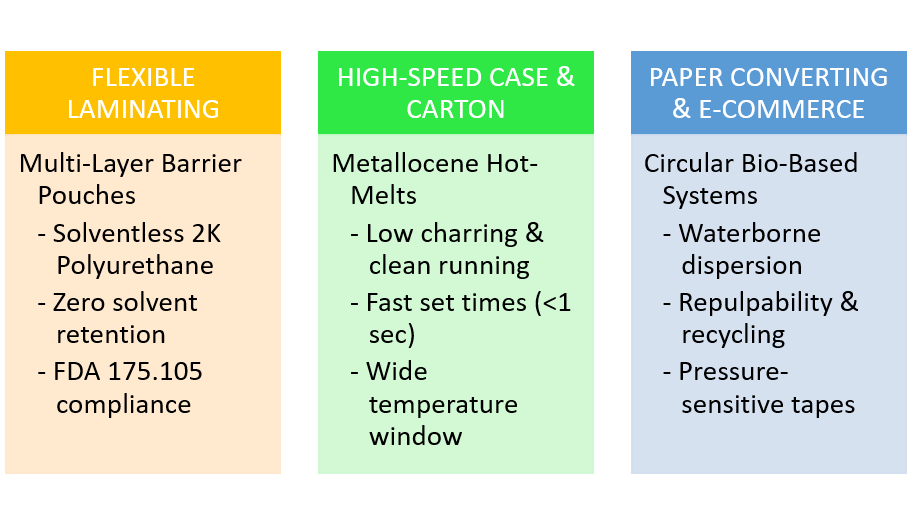
High-barrier flexible pouches (used for dry food, liquid retort food, personal care, and pharmaceuticals) rely on multi-layer laminates that combine dissimilar substrates such as aluminum foil, polyethylene terephthalate (PET), oriented polypropylene (OPP), and polyethylene (PE). In these structures, solventless 2K polyurethane laminating systems are applied at 100 solids using specialized multi-roll solventless coaters at elevated temperatures (), completely eliminating the high energy costs, drying ovens, and Volatile Organic Compound (VOC) emissions associated with legacy solvent-borne acrylic or polyurethane adhesives. Regarding migration and safety regulations under FDA 175.105 and EU 10/2011, food-contact laminates must prevent the migration of toxic low-molecular-weight species into packaged food. Unreacted monomeric aromatic isocyanates (such as monomeric MDI) can react with moisture trapped in food matrices to form carcinogenic Primary Aromatic Amines (PAAs). Advanced formulators mitigate this by utilizing low-monomer (LM) polyurethanes with <0.1 free monomeric isocyanate content, accelerating decay times and guaranteeing zero PAA migration within hours of lamination.
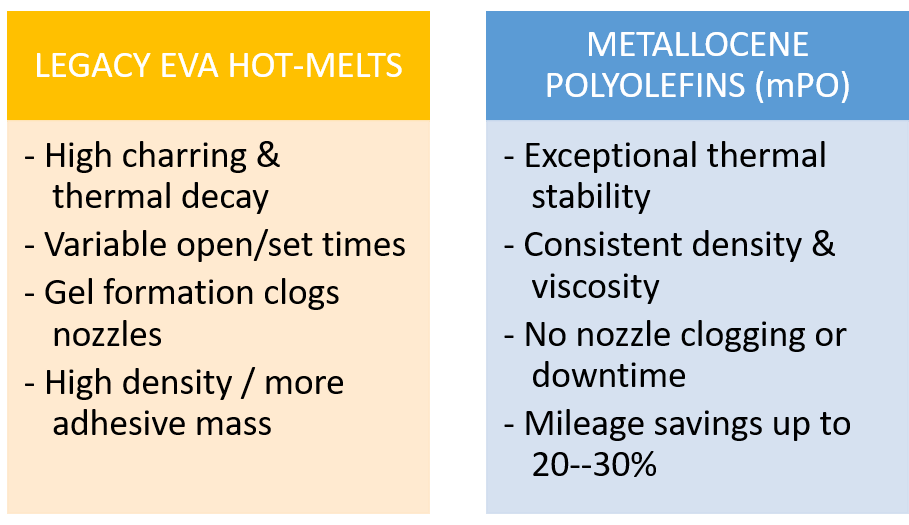
Industrial case sealing and folding carton assembly require instantaneous bond formation to keep pace with modern automated filling lines operating at speeds up to 100+ cases per minute. While legacy Ethylene-Vinyl Acetate (EVA) hot-melts undergo thermal degradation and charring when held in molten glue tanks for extended periods—causing frequent nozzle clogging and machine downtime—the industry has transitioned toward metallocene-catalyzed polyolefin (mPO) hot-melts. Metallocene catalysis delivers narrow molecular weight distributions and complete chemical saturation, yielding high thermal stability with zero char or gel formation after hundreds of hours at , clean jet-dispensing, and set times below 0.5 seconds. Furthermore, mPO formulations maintain high bond strength across severe temperature extremes, resisting pop-opens in deep-freeze cold storage () as well as high-temperature tropical shipping environments ().
The explosive growth of e-commerce packaging, alongside global legislative mandates targeting single-use plastics, has accelerated the shift toward fiber-based paper packaging solutions. To ensure repulpability and circular economy compliance, formulators address the issue where standard synthetic adhesives disrupt paper recycling mills by creating tacky, insoluble agglomerates ("stickies") that blind paper-making screens and tear paper sheets. Advanced paper-converting adhesives leverage modified acrylic emulsions or polyvinyl acetate (PVAc) polymers engineered with targeted solubility parameters; during pulping, these waterborne dispersion formulations coalesce into screenable particles ( ) that are easily screened out to enable certified repulpable and recyclable paper packaging. For e-commerce tamper-evident strips, self-seal shipping boxes and returnable mailers utilize high-tack styrenic block copolymer (SBC)-based pressure-sensitive hot-melts applied onto paper substrates, exhibiting high shear strength and instant fiber-tear adhesion that makes unauthorized package opening impossible without visible structural destruction of the paper fibers.
HOT-MELT ADVANCEMENT IN CASE SEALING
Section 5: Future Horizon – Next-Gen Materials & Strategic Outlook
The global adhesives sector stands at a structural turning point. Historically engineered for maximum permanency, next-generation adhesives are evolving into dynamic, intelligent, and circular materials systems. Driven by stringent global environmental mandates (such as the EU Battery Passport, Right to Repair directives, and strict REACH/PFAS phase-outs), formulators are moving away from traditional petrochemical architectures toward reversible, bio-derived, and self-healing networks.
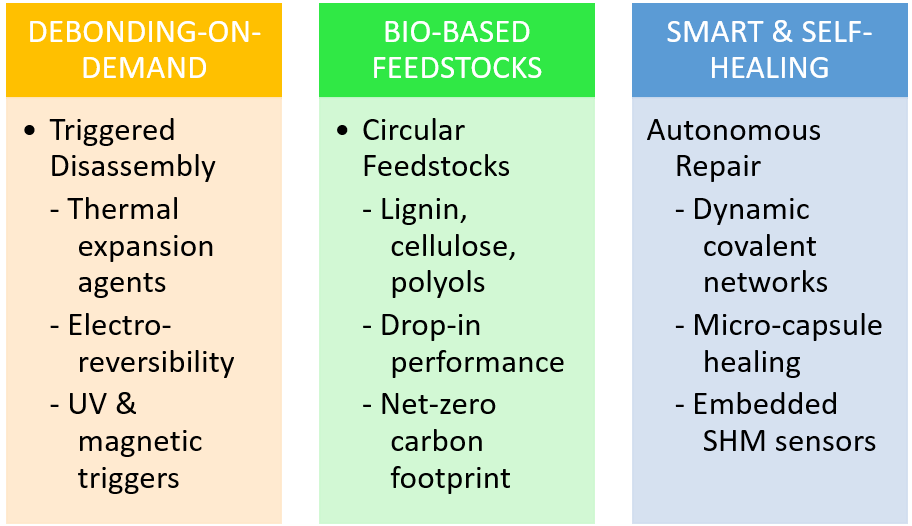
Next-Gen Functional Adhesive Platforms
5.1 Debonding-on-Demand (DoD) & Circular Economy Disassembly
The transition toward a circular economy has exposed a fundamental engineering contradiction: conventional structural adhesives are engineered never to fail, making product disassembly, repair, and component recycling nearly impossible. Debonding-on-Demand (DoD) solves this by introducing targeted stimuli-responsive triggers that maintain high joint strength during product use, but trigger clean separation on command.
- Thermal & Magnetothermal Triggers:
- Thermally Expandable Microspheres (TEMs): Micro-encapsulated physical blowing agents mixed into the adhesive matrix expand up to 50 times their original volume when heated past a specific threshold (), generating internal expansion stress that shatters the adhesive interphase.
- Magnetothermal Nanoparticles: Incorporating iron oxide () nanoparticles allows targeted induction heating via localized high-frequency magnetic fields. This debonds the joint in seconds without exposing heat-sensitive substrates (such as battery cells or optical sensors) to ambient thermal stress.
- Electro-Reversible & Cleavable Formulations:
- Electro-Release Chemistry: Applying a low DC voltage (10--50 V) across a conductive joint triggers localized electrochemical redox reactions at the metal-adhesive interface, cleaving ionic bonds and allowing the adhesive to peel off cleanly without mechanical force.
- Dynamic Covalent & Supramolecular Networks: Thermoreversible Diels-Alder 4+2 cycloadditions enable polymer networks to decouple at elevated temperatures for clean debonding and re-crosslink upon cooling for multi-cycle repair.
5.2 Bio-based & Renewable Feedstocks
Driven by scope 3 emissions targets and volatile petrochemical feedstocks, formulators are shifting toward bio-derived precursors that match or exceed the performance of fossil-based analogs.
- Lignin-Derived Aromatics:
- Replacing Petrochemical Phenols: Lignin—a massive byproduct of the paper and pulp industry—is rich in natural aromatic polyphenols. Enzymatic and catalytic depolymerization converts raw lignin into bio-phenols and bio-epoxies, providing high thermal stability () and moisture resistance in structural adhesives.
- Vegetable Oil & Carbohydrate-Derived Polyols:
- Synthesizing bio-polyols from castor, soybean, and tall oils enables bio-based polyurethane formulations with exceptional flexibility and hydrophobic durability.
- Marine & Polysaccharide Bio-Adhesives:
- Utilizing catechol chemistry derived from mussel adhesive proteins (Mfp-5) and modified chitosan/alginate networks to formulate underwater, high-moisture tissue glues and biodegradable packaging sealants.
5.3 Smart Adhesives & Self-Healing Networks
The frontier of material science lies in converting adhesives from passive mechanical joins into active, self-diagnosing, and self-repairing interfaces.
- Autonomous Self-Healing Networks:
- Micro-Capsule Autonomic Healing: Embedded micro-capsules containing liquid monomer (e.g., dicyclopentadiene) rupture under mechanical micro-cracking, capillary-flowing into the crack void where they encounter pre-dispersed catalysts (e.g., Grubbs' catalyst) to polymerize and restore up to of initial joint strength.
- Intrinsic Self-Healing: Utilizing dynamic reversible hydrogen bonding, disulfide exchange reactions, or boronate ester crosslinks that spontaneously reform across damaged surfaces at room temperature.
- Integrated Structural Health Monitoring (SHM):
- Adhesive matrices embedded with carbon nanotubes (CNTs) or graphene nanoplatelets create piezoresistive percolation networks. Changes in electrical resistance across the bondline provide real-time diagnostic telemetry, detecting internal strain, micro-cracking, and moisture ingress before catastrophic joint failure occurs in aerospace, wind energy, and automotive chassis assemblies.
Conclusion: Strategic Outlook & The Road Ahead
The global adhesives and functional bonding industry has evolved from a traditional chemical subsector into a core strategic driver of modern hardware engineering and sustainable manufacturing. Across every high-value market domain—from battery electric vehicle architectures and semiconductor packaging to 100-meter wind turbine blades, medical wearables, and circular flexible laminates—functional adhesives do more than join substrates. They enable structural lightweighting, solve critical thermal management challenges, guarantee electrical isolation or conductivity, and protect sensitive components under extreme operational environments.
As the industry faces compounding demands around environmental regulation, component recyclability, and manufacturing throughput, competitive advantage will belong to formulators and materials platforms that master three critical frontiers:
- Reversibility without Compromise: Engineering robust Debonding-on-Demand (DoD) mechanisms that maintain structural joint integrity throughout a product's lifecycle, while enabling rapid, non-destructive disassembly for circular recycling and repair.
- Sustainable Feedstock Transition: Decoupling high-performance formulations from fossil fuel derivatives through bio-based polyols, lignin-derived aromatics, and low-VOC/solventless platforms that meet stringent global compliance standards (e.g., REACH, PFAS restrictions, and EU digital product passports).
- Smart & Reversible Interphases: Integrating responsive chemistries—from self-healing polymer networks to embedded structural health monitoring sensors—that elevate adhesives into dynamic, self-diagnosing materials systems.
Ultimately, as materials science and automation continue to converge, the ability to co-engineer bespoke liquid chemistry alongside high-precision dispensing and sub-second curing hardware will define the market leaders of the next decade.